SWISS GOVERNMENT EXCELLENCE SCHOLARSHIPS 2027–2028 — PhD AND RESEARCH OPPORTUNITIES FOR AFRICAN SCHOLARS
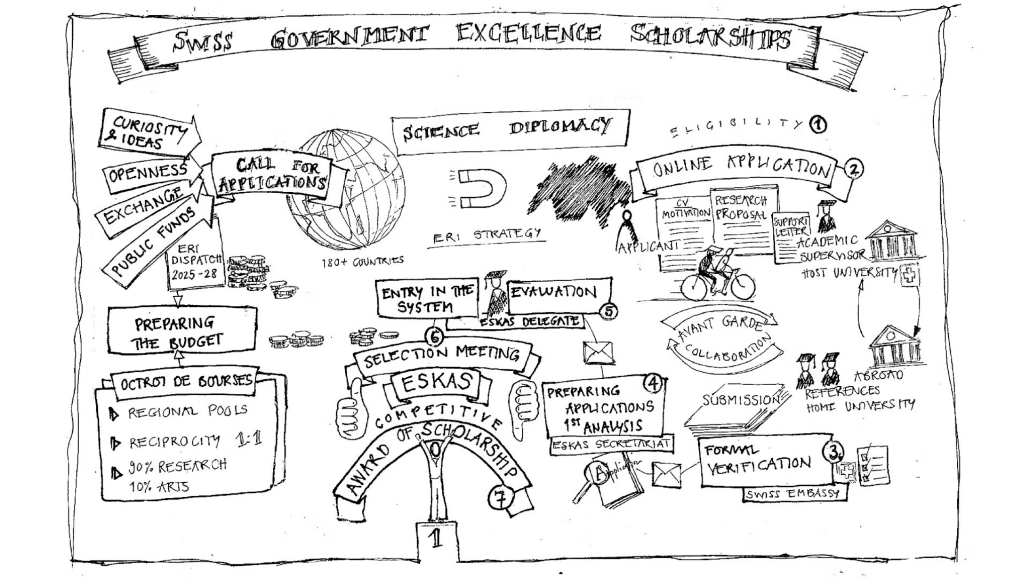
Apply via: sbfi.admin.ch/en/swiss-government-excellence-scholarships
Switzerland has opened applications for its flagship Swiss Government Excellence Scholarships for the 2027–2028 academic year, offering fully funded opportunities for PhD candidates, postgraduate researchers, and artists from over 180 countries. The programme is highly competitive and research-focused, and is especially valuable for African scholars, seeking to build international research collaborations while completing doctoral or post-Master’s research.
The Swiss Government Excellence Scholarships are awarded annually by the Swiss Confederation to promote international exchange and research cooperation between Switzerland and partner countries. Selection is managed by the Federal Commission for Scholarships for Foreign Students (FCS/ESKAS), which evaluates candidates on academic profile, project quality, and potential for future research collaboration.
Scholarship Types for 2027–2028
Three main categories are available for the 2027–2028 cycle, each offering a monthly stipend of CHF 2,450. Research Fellowships are available for PhD candidates who already hold a Master’s and wish to spend 6 to 12 months conducting research in Switzerland as part of their ongoing doctorate. PhD Scholarships support full-time doctoral studies at a Swiss university or research institute, initially awarded for 12 months and renewable up to 36 months. Art Scholarships are available for a first Master’s in music, visual arts, or related fields at a Swiss university of the arts or conservatory, though this category is limited to a select list of countries.
Who Can Apply?
For research and PhD scholarships, core eligibility requirements include:
- Citizenship of an eligible country — most African countries, including Eswatini, are eligible, though applicants should verify this on the SBFI portal
- Being born after 31 December 1991 — a maximum age of 35 at the time of application
- Holding a Master’s degree or equivalent completed by 31 July 2027 (30 June 2027 for ETH Zurich)
- Having a confirmed academic supervisor at a Swiss university, ETH, EPFL, or research institute, who must provide a support letter and short CV — applications without a confirmed supervisor will not be considered
- Priority is given to candidates who have not previously studied or conducted research in Switzerland
Art scholarship applicants must hold a Bachelor’s degree by 31 July 2027, must not already hold a Master’s, and must provide proof of admission or application to a Swiss art school along with a strong portfolio.
What the Scholarship Covers
For non-EU/EFTA scholars, the funding package typically includes:
- A monthly stipend of CHF 2,450 (approximately E58,000 per month) for basic living expenses
- Health insurance premium for compulsory Swiss health insurance
- A one-time rental deposit grant of CHF 600
- A return flight allowance for eligible non-EU/EFTA scholars
- A Swiss Half-Fare Travelcard for discounted public transport
- Organised excursions and networking activities
Costs the applicant must still cover include tuition or semester fees (typically CHF 600 to 2,000 per semester), conference travel, fieldwork costs, and family expenses, the stipend is intended for one person only and does not include family allowances.
Application Timeline
Applications open on 20 August 2026 via the online Grants Online (GO ESKAS) system. Country-specific deadlines are set individually by each Swiss embassy or representation and vary widely, published from August 2026 onward. Decisions are expected to be announced by end-May 2027, ahead of the September 2027 programme start.
For Eswatini applicants, the relevant point of contact is the Embassy of Switzerland in Pretoria, which serves as the Swiss diplomatic mission responsible for Eswatini. Applicants can be reached and can direct enquiries to:
- Email: pretoria.science@eda.admin.ch
- Phone: 0027 12 452 0695
Applicants are strongly encouraged to contact the Embassy directly to confirm the exact country-specific deadline and application procedure for Eswatini.
How to Apply
- Confirm your country’s deadline and the scholarship types available on the SBFI portal, published from August 2026, or by contacting the Swiss Embassy in Pretoria directly
- Identify and contact a Swiss supervisor, a professor or lab group leader whose work aligns with your proposed project and request a support letter and short CV
- Prepare all required documents for submission via Grants Online (GO ESKAS), including:
- A full CV covering education, degrees, awards, positions, publications, and teaching or practical experience
- A motivation letter of maximum two pages explaining your reasons for choosing Switzerland, the career significance of the scholarship, and your post-scholarship plans
- A research proposal of maximum five pages on the official FCS/ESKAS form, including a non-specialist summary, timeline, and milestones
- Your supervisor’s support letter and short CV (maximum two pages)
- Two referee emails — the system will request recommendation letters directly via the FCS/ESKAS form
- Certified transcripts and certificates, with translations if not in English, French, Italian, or German
- A copy of your passport (both passports if a dual citizen), and residence permit or registration documentation if already in Switzerland
- For PhD candidates at graduate schools: confirmation of admission to the graduate school
- For art scholarship applicants: a portfolio and proof of admission or application
- Submit your application online before your country’s specific deadline — paper or email applications are not accepted
Selection Criteria
The FCS assesses applications across three key pillars: candidate profile (academic excellence, relevant experience, publications or outputs), project quality (originality, methodological soundness, feasibility, and clarity of the research plan), and synergies (fit with the Swiss host institution, quality of proposed supervision, and potential for future research cooperation).
Art scholarship applications are assessed on artistic profile, portfolio strength, and enrolment feasibility at the chosen school.
Common Pitfalls to Avoid
Applicants should be aware of the following common mistakes: applying without a confirmed Swiss supervisor (such applications are automatically rejected); missing the country-specific deadline, as there is no single global deadline; submitting an incomplete research plan that lacks a non-specialist summary, clear objectives, methods, timeline, and milestones; and late document preparation, as certified translations and copies take time to obtain.
Applicants are reminded that the State Secretariat for Education, Research and Innovation (SERI) has warned against fraudulent offers requesting payment for visa or insurance fees. The scholarship application process is entirely free of charge.
Why This Scholarship Matters for African Scholars
This scholarship stands as one of the most accessible fully funded routes for African Master’s degree holders to pursue doctoral or post-Master’s research in Europe, with a strong emphasis on building long-term research partnerships. The monthly stipend, health insurance, travel allowance, and mobility benefits make it financially viable for scholars from the country and across the continent to focus on high-quality research without significant out-of-pocket costs.
Next Steps for Applicants
From 20 August 2026, applicants should monitor the SBFI page for Eswatini or contact the Embassy of Switzerland in Pretoria directly to confirm the exact deadline and which scholarship types are available. Prospective applicants are encouraged to begin outreach to potential Swiss supervisors now, sharing a concise one-page concept note along with their CV, and to begin drafting their five-page research plan using the official FCS/ESKAS template while lining up two referees early in the process.
Information correct at time of publication. Likusasa Letfu is not liable for any changes made by the awarding institution. Always verify details at the official scholarship portal.
Ongoing Scholarships
- DAAD OPENS STEM SCHOLARSHIP FOR TUITION – FREE MASTER’S STUDY IN GERMANY
Deadline: 21 October 2026 (applicants should confirm with the relevant sources)
Apply at: daad.de
The German Academic Exchange Service (DAAD) has opened applications for its Study Scholarships for STEM Disciplines 2027/28, targeting high-achieving graduates from developing and emerging countries who wish to undertake a full-time Master’s degree in Germany.
What the Scholarship Covers
The scholarship supports study in mathematics, computer science, natural sciences, and engineering. Eligible programmes must be full-time Master’s degrees delivered on campus in Germany at a state or state-recognised university, must be tuition-free, and must commence in the winter semester of 2027/28. Interdisciplinary degrees may qualify where their core focus falls clearly within one of these fields, though applicants are advised to review the curriculum carefully; a programme containing only a small number of STEM modules is unlikely to satisfy this requirement.
It is worth noting that the scholarship cannot fund a Master’s degree already underway in Germany, and programmes that include study periods outside the country may not qualify. Funding typically runs for between 10 and 24 months, depending on the length of the chosen programme, with funding expected to commence around the start of the 2027 winter semester.
Financial Support
Successful applicants receive a monthly scholarship of €992 to assist with living expenses. Depending on individual circumstances, the scholarship may also include contributions toward health, accident, and personal-liability insurance; a travel allowance; an annual study allowance of €460; rent and family allowances where applicable; support for an eligible German-language course; reimbursement of eligible carbon-offset costs for air travel; and possible additional support for scholars with a disability or chronic illness.
Tuition fees are not covered under this scholarship. Applicants must therefore select a tuition-free programme and budget separately for costs such as visa fees, deposits, and local transport. For this reason, the opportunity is more accurately understood as DAAD-funded support for tuition-free study, rather than a fully funded scholarship in the broader sense.
Eligibility Requirements
To be considered, applicants must generally meet the following:
- Hold citizenship of an eligible developing or emerging country
- Hold a first university degree recognised in Germany, normally a Bachelor’s degree, held or completable by the application deadline
- Have obtained their first degree no more than six years before the application deadline, as a general rule
- Demonstrate above-average academic performance
- Meet the admission requirements of the chosen German university
- Provide the required language certificate
- Not already hold a Master’s degree by the application deadline
- Not have lived in Germany for more than 15 months at the application deadline
Meeting these general requirements does not guarantee selection. The selection committee also weighs the applicant’s academic record, motivation, study plan, professional experience, leadership, and social engagement.
Language Requirements
The DAAD programme requires a minimum of B1 proficiency for the scholarship application itself, though individual universities may set a higher standard — an English-taught programme may require IELTS or TOEFL, while a German-taught programme requires a recognised German-language qualification. Applicants are cautioned not to assume that a B1 certificate alone will satisfy university admission requirements and should verify the exact language requirement for each programme under consideration.
Required Documents
Applicants must prepare the following documents:
- A curriculum vitae in tabular form, normally no longer than three pages
- A motivation letter of approximately one to three pages
- A completed DAAD form listing up to five preferred Master’s programmes
- A current transcript of records
- A university degree certificate, if already completed
- Academic transcripts for completed studies
- A language certificate
- One DAAD recommendation form completed by a university lecturer
- A passport or national identity document
- An admission letter from a German university, if already available
Applicants may also submit supporting evidence of professional experience, internships, leadership roles, or social engagement. Documents not in English or German generally require translation into one of these languages.
Deadline and Application Process
The DAAD scholarship database currently lists 21 October 2026 as the application deadline for the 2027/28 cycle, though a separate DAAD regional announcement has shown 30 September 2026, which may reflect a country-specific deadline. Applicants from Eswatini are strongly advised to confirm the deadline that applies to them directly through the DAAD portal, rather than relying on a date shared through social media or a third-party site.
The application process involves two separate steps: applying for admission to one or more suitable German Master’s programmes, and submitting a scholarship application through the DAAD portal. A DAAD scholarship application does not replace university admission, and the scholarship can only be used if the applicant is admitted to an eligible programme.
Final Advice for Applicants
Prospective applicants are encouraged to begin by identifying suitable programmes rather than applying for the scholarship without a clear study option in mind, comparing curriculum, tuition policy, language requirements, and deadlines across universities. A programme should not be selected simply because it appears on a general scholarship list — it must meet the DAAD’s STEM conditions, and the university must independently confirm that the applicant satisfies its own admission requirements.
Information correct at the time of publication. Deadlines, eligibility rules, funding conditions and university requirements may change. Applicants should verify all information directly with DAAD and the selected German universities before applying. Likusasa Letfu is not responsible for changes made by the awarding institution.
- MASTERCARD FOUNDATION SCHOLARS PROGRAM AT UBC 2027 — MASTER’S FOR AFRICAN STUDENTS
Deadline: 6 September 2026
Apply at: mastercardfdnscholars.ubc.ca
The University of British Columbia (UBC), in partnership with the Mastercard Foundation, is inviting applications for the Mastercard Foundation Scholars Program (Master’s level) for the Winter 2027 intake. This fully funded opportunity targets academically talented young Africans committed to using their education to drive economic growth and social transformation in their home communities.
What the Programme Offers
UBC and the Mastercard Foundation aim to support 351 young African scholars with Master’s-level study at UBC, building on a first phase that already supported over 171 scholars. Upon graduation, scholars are expected to apply their skills in areas such as agriculture, food systems, forestry, environment, and data science to strengthen communities and economies across Africa.
Eligible Master’s Programmes
The scholarship covers only the following programmes:
Faculty of Land and Food Systems
- Master of Food and Resource Economics (MFRE)
- Master of Food Science (MFS)
Faculty of Forestry
- Master of Sustainable Forest Management (MSFM)
- Master of International Forestry (MIF)
- Master of Urban Forestry Leadership (MUFL)
- Master of Geomatics for Environmental Management (MGEM)
- Master of Science / Master of Applied Science in Forestry (thesis-based)
Faculty of Science
- Master of Data Science
Who Is Eligible?
To qualify for the scholarship, applicants must:
- Have completed a Bachelor’s degree
- Not already hold a Master’s degree
- Be 35 years old or younger at the time of application (born in 1990 or later)
- Be a citizen or refugee of an African country
- Be applying to one of the eligible Master’s programmes listed above
- Meet UBC’s minimum academic requirements for the chosen programme
- If the Bachelor’s degree was not taught in English, provide TOEFL or IELTS results sent directly to UBC
Application Process and Timeline for Winter 2027
Applications for the Winter 2027 intake open on 31 August 2026 and proceed through four clear stages.
Step 1: Expression of Interest (EOI) — deadline 6 September 2026. There are two application streams: the General Stream, for all eligible African candidates except refugees, and the Refugee and Displaced Persons Stream. Only candidates who submit an EOI and meet the eligibility criteria will be invited to complete the full application.
Step 2: Round 1 — Mastercard Foundation Scholars Program Application. Invitations are sent between 15 and 30 September 2026. The required application includes a completed application form with personal statements, a CV or résumé, two reference letters on official letterhead attached directly to the application, and academic transcripts. Selection at this stage is based on academic merit sufficient for admission to the chosen programme, a track record as a transformative leader with evidence of community service, the quality and fit of the application with the programme’s theme, and the applicant’s potential impact on their home country.
Step 3: Round 2 — UBC Faculty Application, open from 1 to 20 November 2026, with late applications not considered. Successful Round 1 applicants receive instructions to apply directly to their chosen UBC faculty. Applicants from UN-listed least developed countries may be eligible for an application fee waiver, though this must be requested and applied correctly at the time of application, as no refund is possible afterward.
Step 4: Interviews and Offers. Interviews for shortlisted candidates take place between December and January, with scholarship offers sent to selected scholars in February. Scholars are expected to arrive in Vancouver for the Winter term in August.
Why This Matters for African Youth
This scholarship is more than funding — it is a leadership pipeline. It is designed for young Africans already active in their communities and ready to scale their impact through advanced training in strategic sectors such as food security, sustainable forestry, environmental management, and data-driven decision-making.
How to Get Started
Prospective applicants should confirm their eligibility using UBC’s international credentials page for their country, choose their preferred programme or programmes from the eligible list, and begin preparing documents early — including transcripts, a CV, and referees who can write strong, specific letters on official letterhead. Applicants must submit their Expression of Interest before 6 September 2026 via the appropriate stream.
For questions, contact scholars.admissions@ubc.ca.
Information correct at time of publication. Likusasa Letfu is not liable for any changes made by the awarding institution. Always verify details at the official scholarship portal.


Leave a Reply
Want to join the discussion?Feel free to contribute!